A1 Submarine
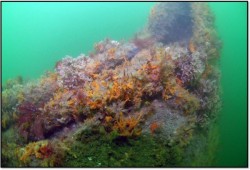
The A1 Submarine is a Historic Protected Wreck and a key location for sediment and biota monitoring for the CHASM project because, being a fixed point on the seabed, it is relatively easy to access and monitor. We are extremely fortunate that the Wreck Licensee Martin Davies is a big supporter of CHASM, and has enabled a huge amount of in situ sediment data to be gathered in the vicinity of the A1 and from other local sites.
The sediment data gathered for CHASM in the early 2020's was further informed by an earlier project on scour around the A1 by a student at the University of Southampton. The student report, undertaken 10 years earlier than the initial CHASM studies, created a baseline against which CHASM and other geospatial data from the area could be compared. The resulting CHASM Sediment Report was released in early 2025.
The A1 submarine was Britain’s first ever designed and built submarine, it superseded the Holland class and was 30% larger able to dive for longer and with more endurance. The vessel was lost in the Eastern Solent in 1911, and remained undiscovered until 1989 when the wreck was discovered by a local fisherman.
It is thought that she was only partially flooded when she sank, and the resulting partial buoyancy meant that the wreck moved in the strong local currents. The wreck was designated under the Protection of Wrecks Act on 26 November 1998 and redesignated to extend the area covered on 5 October 2004.
Martin Davies has been Licensee for the Historic Protected Wreck of Submarine A1 since 2006. The role involves monitoring the site for decay and site stabilisation, and allowing divers to access the site through the license scheme administered by Historic England and DCMS. The reporting of illegal activity such as commercial fishing or potting or even unlicensed divers is is also part of the role and each year a general report is done on the site condition and activity.
Anyone wishing to dive the site must contact Martin Davies directly via the In Depth Photography contact form to be granted access and permission to dive the site.
Each year a report on the wreck condition is submitted to Historic England. These reports were an extremely important baseline for CHASM in the early stages by defining underwater change at a fixed site as observed by divers over a number of years.
Follow this link to read more about the A1 submarine and access the A1 reports to Historic England.
CHASM Project Area
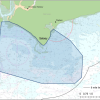
The initial CHASM Project Area shown on the map covers the inshore fishing ground of the Manhood Peninsula. However, decline in crab and lobster catch, the decline in sea water and habitat quality, and the increased quantity of marine sediment are being seen elsewhere along the UK south coast, and may reflect wider issues though it is not... Read More»
2022 CHASM Film

Fishing has been a part of Selsey Bill, West Sussex and the surrounding areas since the Bronze Age. Local fishermen tell of huge changes to the fishing grounds in recent years, about the small numbers of lobsters being caught locally, and large influxes of sediment arriving in their fishing grounds. Needing to understand these changes led to the development of... Read More»
2024 CHASM Sediment Report

This report provides an update of analysis conducted as part of the CHASM (Crustacean, Habitats and Sediment Movement) project carried out by the University of Southampton in summer 2024. It seeks to understand environmental change from a sediments perspective, and sets out to answer a series of questions using various data sources and analysis. The questions are: 1. What sediments... Read More»